
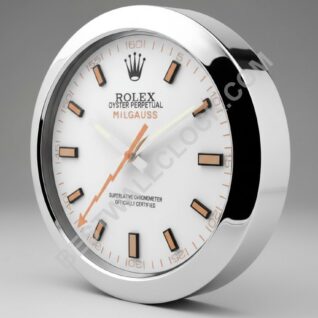
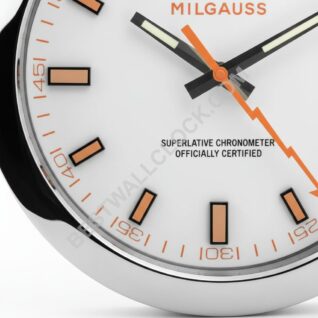
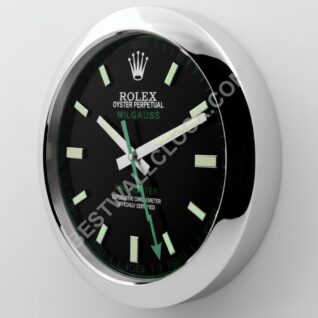

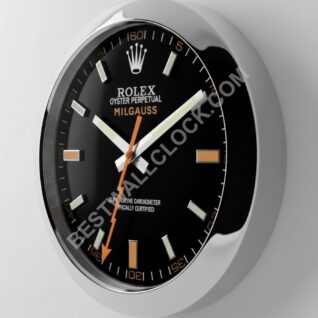

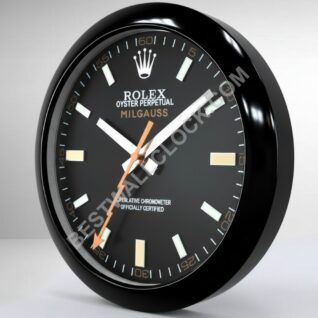

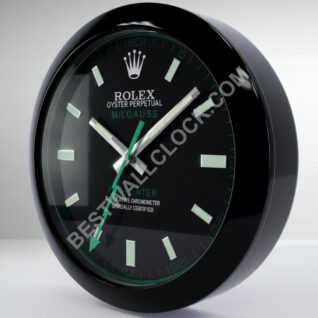


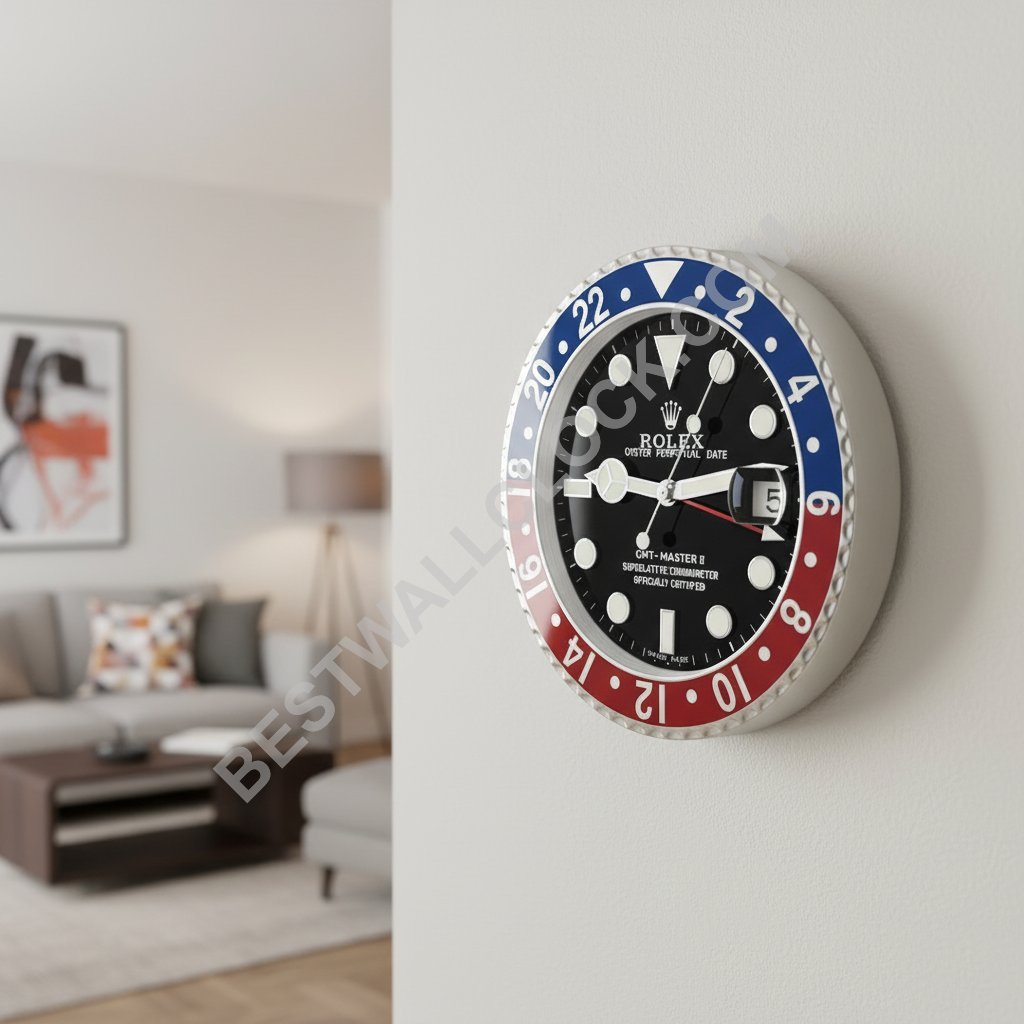
The GMT-Master II Dealer Display is a reference-level wall instrument designed to translate the functional density of a dual-time complication into a large-format architectural fixture. Characterized by its bi-directional, two-tone bezel, this showroom edition serves a specific utilitarian mandate: the visual separation of day and night hours. Whether executed in the heritage-driven "Pepsi" (Blue/Red) or the modern industrial "Batman" (Blue/Black) configuration, these 38cm timekeepers are not merely decorative—they are historical markers of the jet age, re-engineered for the executive interior.
The Pan-Am Mandate and the Ceramic Shift
To understand the gravity of these two distinct references, one must look past the aesthetics and into the operational history of the GMT lineage. The GMT-Master II was born from necessity, not vanity. In the mid-1950s, Pan American World Airways required a tool watch capable of tracking Greenwich Mean Time (GMT) alongside local time for their transcontinental flight crews. The solution was the "Pepsi" bezel: a stark, bichromatic ring where red signified daylight hours and blue signaled the night. This was a safety instrument first, a luxury object second.
For decades, the Red and Blue insert was the singular definition of the traveler's watch. It represents the "Golden Age" of aviation—a time of aluminum fuselages, analog cockpits, and romance. A "Pepsi" Dealer Display in a room anchors the space in this mid-century heritage. It is warm, vibrant, and undeniably loud in its historical signaling.
Conversely, the "Batman" (Black and Blue) represents the modern era of material science. Introduced initially on the wrist in 2013, the BLNR (Bleu/Noir) colorway signaled the triumph of Cerachrom technology. Manufacturing a single-piece, two-tone ceramic bezel was deemed metallurgically impossible until Rolex achieved it. The "Batman" Dealer Display sheds the vintage warmth of the Pepsi for a colder, more authoritative presence. It aligns with the glass-and-steel aesthetics of modern architecture. Where the Pepsi is a nod to the pilot, the Batman is a nod to the CEO—stealthy, corporate, and relentlessly precise.
Choosing between them is not a matter of color preference; it is a choice between two distinct eras of horological philosophy.
The Architecture of Time: 304L Steel and Silent Mechanics
The distinction between a novelty item and a "Reference Level" instrument lies almost entirely in mass and metallurgy. When you handle a GMT-Master II Dealer Display, the first sensory input is the thermal conductivity of the case. We utilize a solid block of 304L Stainless Steel, milled to archive specifications. This is not a plastic composite disguised with metallic paint; it is cold, dense alloy. Weighing in at approximately 1.6kg (3.5 lbs), the clock requires a reinforced anchor point. It possesses a gravitational authority on the wall that flimsy substitutes simply cannot achieve.

The defining engineering challenge of the GMT-Master II, particularly in the "Batman" (BLNR) configuration, is the bi-chromatic bezel. On a wristwatch, achieving a seamless transition between black and blue ceramic was a decade-long industrial hurdle. Translating this to a 38cm scale requires similar precision. The transition point at the 6 and 18 numerals must be sharp and deliberate. There is no bleeding; the demarcation between the "night" (Black) and "day" (Blue) sectors is executed with clinical exactitude, protected behind a heavy gauge mineral glass crystal that mimics the refractive index of sapphire.
However, the "heart" of these Showroom Editions is the **Gen-II Silent Sweep** movement. Standard quartz movements operate on a 1Hz frequency, resulting in the distinct, staccato "tick-tick-tick" associated with low-tier manufacturing. This auditory signature is unacceptable in an executive environment.

Our archive-spec units utilize a high-torque, continuous-sweep quartz module. The seconds hand glides across the dial with a fluidity that mirrors the 28,800 beats per hour (vph) of a mechanical caliber. There is no ticking, no stutter, and arguably most importantly—no noise. In a silent boardroom or a quiet study, the clock remains visually dominant but acoustically invisible, preserving the focus of the room's occupants.
Spatial Psychology: Chromatic Authority in Interior Design
The selection of a Dealer Display is rarely about telling time; it is about defining the temperament of a room. The GMT-Master II, in its 38cm format, acts as a visual anchor that dictates the "temperature" of an interior space.
The "Pepsi" (Blue/Red) is inherently warm and nostalgic. It carries the visual vernacular of the 1950s jet set. Consequently, it thrives in environments rich in organic textures—mahogany bookshelves, Chesterfield leather sofas, and spaces with warm, tungsten-style lighting. It is a conversation piece that signals an appreciation for heritage and the romance of analog travel. It breaks the monotony of a neutral wall with a deliberate, historic clash of primary colors.
In sharp contrast, the "Batman" (Blue/Black) is a creature of the modern metropolis. It is cool, detached, and surgically clean. This reference is best deployed in "high-gain" environments: minimalist offices, monochromatic grey interiors, and spaces defined by concrete, glass, and cool-white LED lighting. The black half of the bezel absorbs light, allowing the blue sector to act as a subtle, electric accent. It does not scream for attention; it commands it through stealth.
Optics and The Cyclops Signature
Regardless of the colorway, both references share the defining optical trait of the GMT lineage: the Cyclops lens. On the wrist, this magnification bubble at the 3 o'clock position serves to enlarge the date aperture by 2.5x. On a wall clock of this magnitude, the Cyclops is no longer strictly functional for legibility—the date is visible from across the room regardless—but it remains a critical component of the visual silhouette.
Without the distortion and light play of the Cyclops, the face would feel flat and unanchored. The lens catches ambient light, creating a focal point that breaks the symmetry of the dial. Combined with the "Maxi" dial layout—featuring enlarged geometric lume plots—the face of the clock maintains high contrast and legibility even in low-light conditions. The result is an instrument that feels "active" and readable from any angle in a large executive suite.
People Also Ask (Technical FAQ)
What is the power reserve of the Gen-II Silent Sweep movement?
The movement operates on a single AA battery (High-Alkaline recommended). Due to the continuous torque required to drive the sweeping seconds hand, battery life is approximately 12 to 15 months depending on the brand of cell used.
Does the bezel rotate on the Dealer Display?
No. Unlike the wristwatch counterpart which features a bi-directional rotating bezel for tracking a third timezone, the bezel on the 38cm Dealer Display is fixed. It is a static architectural element designed to preserve the correct vertical alignment of the numerals.
How do I mount a 1.6kg steel clock safely?
Do not use adhesive strips. The 304L steel case is too dense for friction-based mounts. The back of the case features a reinforced hanging integration. We recommend using a drilled wall anchor and screw capable of supporting at least 5kg to ensure a "zero-vibration" flush mount against the drywall or timber.
Is the lume reactive?
The hour markers and hands feature luminescent strips that absorb ambient UV light during the day. In low-light conditions, they emit a soft phosphorescent glow, mimicking the Chromalight display of the reference watch.
Verdict: The Executive's Choice
The decision between the GMT-Master II "Batman" and the "Pepsi" is not merely a question of matching curtains or carpets. It is a choice of narrative. The Pepsi is a celebration of the golden era of flight—a warm, nostalgic nod to a time when travel was an event. The Batman is a celebration of modern precision—a cold, calculated instrument for the contemporary operator.
Both Dealer Displays offer the same tactile authority: the cold steel, the silence of the sweep, and the visual weight of an archive-spec instrument. They are not time-tellers; they are totems of industrial capability, scaled up for the spaces where decisions are made.